Lumped-Element Detectors
How Lumped-Element Detection Works
In a conventional microwave cavity haloscope, the detector volume must be comparable to the Compton wavelength at the target axion frequency, which confines cavity-based searches to axion masses above roughly 1 μeV. At lower masses, the Compton wavelength far exceeds the detector size, rendering microwave cavities as an nonviable detection method. At these wavelengths, the axion-induced signal is in phase across the entire detector and all the detector components can be represented as standard circuit elements (inductors, resistors, etc.). This is the lumped-element regime .
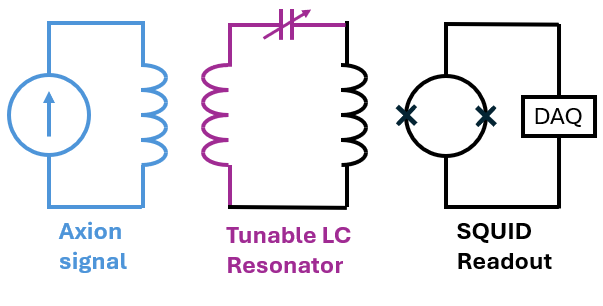
In the lumped-element regime, the axion acts as an effective current source. A superconducting pickup can be used to measure the induced current in response to the axion signal. The pickup is connected to an LC resonator, an electrical circuit that responds strongly to one particular frequency. When this frequency matches the axion signal, the signal is greatly enhanced. Finally, a quantum sensor measures and further amplifies the signal. The resonant frequency of a lumped-element detector can be tuned, like a radio, enabling the detector to cover a large range of possible axion masses.
Current-Generation Experiments
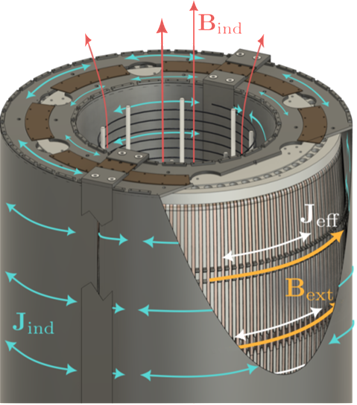
Our group is a member of the DMRadio collaboration. DMRadio is pioneering the development of lumped-element detectors to search for axions at neV masses. There are two current-generation lumped-element experiments in the DMRadio program. DMRadio-50L uses a toroidal magnet and is currently commissioning at Stanford. CAL-Pathfinder is a demonstrator for using solenoid magnets and is under construction at UC Berkeley. Both experiments will reach unexplored areas of the axion parameter space, while also paving the way for future, large-scale lumped-element detectors.