Dark Matter & Axions
What Is Dark Matter?
The first systematic evidence for missing mass came from galaxy clusters. In 1933, Fritz Zwicky applied the virial theorem to velocity dispersions measured in the Coma Cluster, inferring a total gravitational mass hundreds of times greater than the luminosity of its member galaxies could account for. He coined the term dunkle Materie—dark matter—to name the unseen component. Zwicky's contribution was foundational not merely for what he found, but for how he found it: by decoupling mass from light, he established the central method of all subsequent dark matter studies. Mass inferred from gravitational dynamics is independent of whether the source emits radiation, making dark matter detectable even before it is understood.
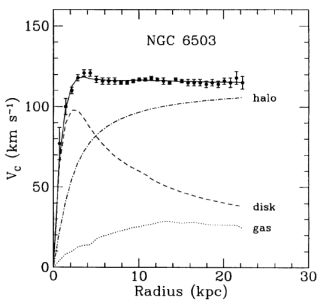
The most direct kinematic evidence came from the rotation curves of spiral galaxies. Through the late 1960s and 1970s, Vera C. Rubin and W. Kent Ford measured how fast stars and gas orbit the centers of dozens of spiral galaxies at increasing distances from the core. If a galaxy's mass were concentrated in its bright stellar disk, orbital speeds should fall off with distance once you move beyond the visible stars—just as planets farther from the Sun move more slowly. Instead, Rubin and collaborators found that orbital speeds stay roughly constant out to the very edge of what could be measured, implying extended halos of invisible mass.
Crucially, this result did more than add to the evidence for missing mass: it directly answered the skeptics of Zwicky's cluster work. One could always argue that Zwicky had simply miscounted the ordinary matter in the Coma Cluster—overlooked dim stars, cool gas, or dust. But Rubin's flat rotation curves continued well past the point where the stellar disk fades away entirely. Any uncounted ordinary matter would have to sit alongside the luminous matter; it could not explain gravity that keeps pulling on stars beyond the visible edge of the galaxy. The excess mass had to form an extended, invisible halo with no luminous counterpart whatsoever.
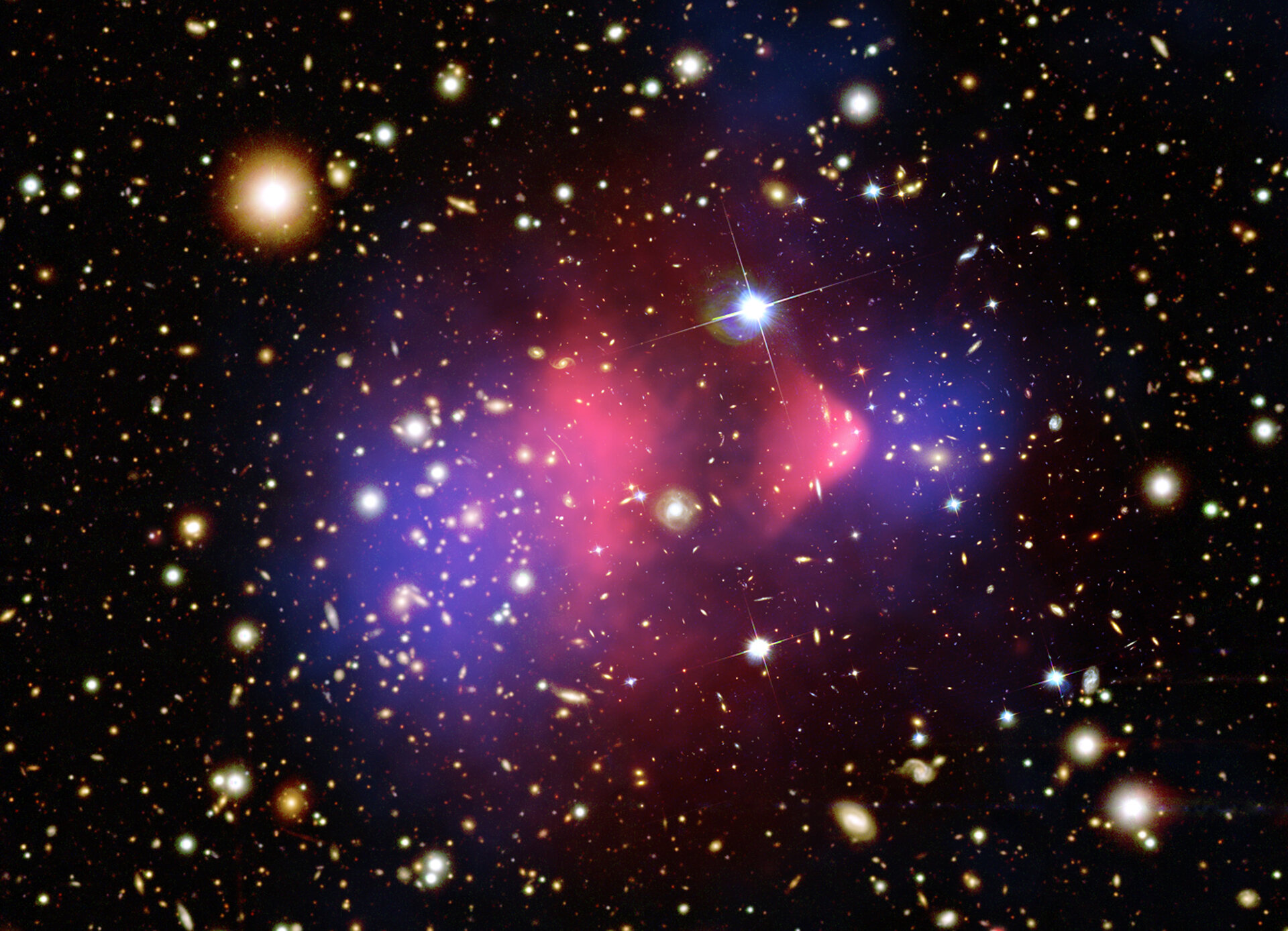
Later observations continued to reinforce these ideas. Gravitational lensing made it possible to map mass directly from how gravity distorts the light of more distant background galaxies. Systems such as the Bullet Cluster provided especially striking evidence: two galaxy clusters that collided and passed through each other, leaving their hot gas behind while their dark matter halos sailed through unimpeded. The hot X-ray-emitting gas, which contains most of the ordinary matter, is spatially separated from the dominant gravitating mass inferred from lensing—catching dark matter in the act of decoupling from ordinary matter.
Independent lines of evidence converge on the same conclusion. The acoustic peak structure of the cosmic microwave background (CMB), measured with precision by WMAP and Planck, encodes the relative densities of baryons, photons, and dark matter through their imprint on primordial sound waves. These data establish that dark matter constitutes roughly 26.8% of the total energy content of the Universe—approximately five times the baryon density—and that it must be cold and effectively collisionless to reproduce the observed peak heights and positions. Simulations of large-scale structure formation further show that the observed cosmic web of filaments, voids, and clusters could not have assembled in the available time without the gravitational scaffolding of a matter component that begins clustering before ordinary matter decouples from the photon bath (Bertone & Hooper 2018).
Why Axions?
The Strong CP Problem
One of the greatest unresolved puzzles in quantum chromodynamics, the theory of the strong force, is why the strong force does not appear to violate charge conjugation and parity symmetry, usually called CP symmetry. Charge conjugation swaps particles' electric charge, while parity reflects a process in a mirror (x,y,z->-x,-y,-x). CP symmetry means the laws of physics remain unchanged after doing both. QCD contains a theta angle that could allow this symmetry to be violated, but experiments have not found the CP-violating effects that a sizable theta angle would produce, constraining it to be less than about one part in ten billion. Peccei and Quinn proposed a way to make this smallness natural by turning the theta angle from a fixed parameter into a dynamical field. As the universe cools, that field settles toward the value where strong CP violation disappears. The axion is the particle left behind by this mechanism, making it a dark matter candidate that began as a solution to an independent problem in particle physics.
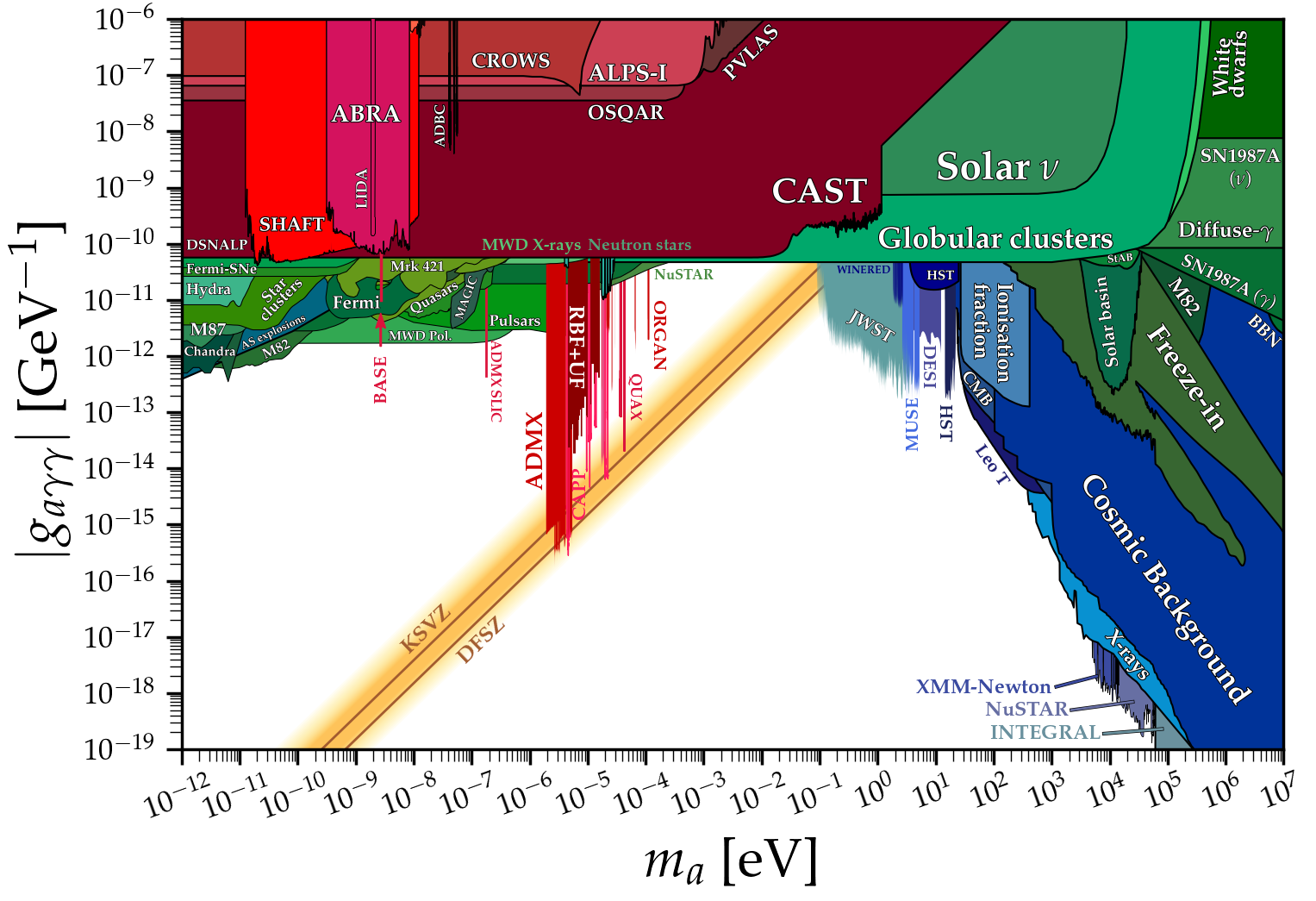
In QCD axion models, the axion mass and interaction strength are tied to the Peccei-Quinn symmetry-breaking scale. A higher symmetry-breaking scale produces a lighter, more weakly coupled axion, which is why invisible axion models such as KSVZ and DFSZ can evade ordinary particle searches while remaining theoretically motivated. These models define the QCD axion band, the region of axion parameter space where the particle would solve the strong CP problem. Axion-like particles extend the same experimental idea beyond this band. They can be light, weakly coupled, and serve as the dark matter, but they do not solve strong CP.
Cosmological Production
Axions are compelling as dark matter because their production mechanism gives them a natural way to become cold and abundant. A dark matter candidate must be abundant enough to supply the missing mass inferred from cosmology, and it must be cold enough to clump gravitationally into galaxies and large-scale structure rather than streaming freely through the universe. When Peccei-Quinn symmetry breaks, nothing requires the axion to start at the value that will later cancel strong CP violation. Early cosmic expansion holds it nearly fixed, leaving energy stored in this initial displacement. As the universe cools and QCD effects become important, the axion begins to move toward its preferred value. It rolls, oscillates, and eventually behaves like cold matter on cosmic scales.
This origin is different from the production of ordinary particles in a hot thermal bath. The axions that make up the dark matter are not produced through frequent collisions with Standard Model particles. They arise from the collective motion of a field that was already present in the early universe, so even extremely light axions can contribute mass gravitationally without behaving like hot radiation.
The details depend on when Peccei-Quinn symmetry breaks relative to inflation. If it breaks after inflation, different regions of the universe begin with different axion values, creating a cosmic patchwork. Boundaries between mismatched regions can form string-like and wall-like defects, whose later decay adds axions to the population produced by misalignment. If the symmetry breaks before or during inflation and is not restored afterward, inflation stretches one initial axion value across the observable universe, removing this visible patchwork but making the abundance depend on that single starting value. This pre-inflationary picture is especially important for very light, high-scale axions. For these masses, the axion field varies over distances much larger than the detector. Experiments like DMRadio-50L and CAL-Pathfinder are designed for this long-wavelength limit, where the signal can be treated as a coherent field coupled to a lumped-element circuit rather than as a microwave mode inside a wavelength-sized cavity.
Axion-Photon Coupling
The axion-photon coupling gives experiments a way to search for a particle that otherwise barely interacts with ordinary matter. An axion will not leave a charged track in a detector, but a strong magnetic field can convert part of the axion field into an electromagnetic response. This conversion is known as the inverse Primakoff effect, and it is the reason magnets are central to many axion searches.
The coupling can be summarized by a term proportional to (a, E·B), linking the axion field to electric and magnetic fields. For dark matter axions, the signal is better understood as a wave passing through the laboratory than as a sequence of individual collisions. Because the axions are extremely light and numerous, the local dark matter field oscillates coherently. When that field overlaps with a static magnetic field, the axion-photon interaction makes the detector behave as though a tiny alternating current is flowing along the magnetic field lines. That effective current produces a real electromagnetic signal whose frequency is set by the axion mass.
The appropriate detector design changes with the axion mass. At higher masses, microwave cavity haloscopes can enhance the signal when a cavity mode matches the axion frequency. At lower masses, the axion wavelength becomes too large for a practical cavity. Lumped-element detectors avoid this scaling problem by treating the experiment as an electrical circuit. The axion-induced response couples into a pickup structure, a resonant LC circuit enhances the chosen frequency, and a SQUID or other quantum sensor reads out the tiny current or magnetic flux.
CAL and DMRadio apply this low-mass strategy in a solenoidal geometry, where the axion-induced response is coupled into a pickup and measured with sensitive quantum electronics. These experiments target the low-mass region where the axion can behave as a coherent wave and where larger instruments can move toward the QCD axion band.
Sources
- K. G. Begeman, A. H. Broeils, & R. H. Sanders, “Extended rotation curves of spiral galaxies: dark haloes and modified dynamics,” Monthly Notices of the Royal Astronomical Society 249, 523–537 (1991). DOI: 10.1093/mnras/249.3.523